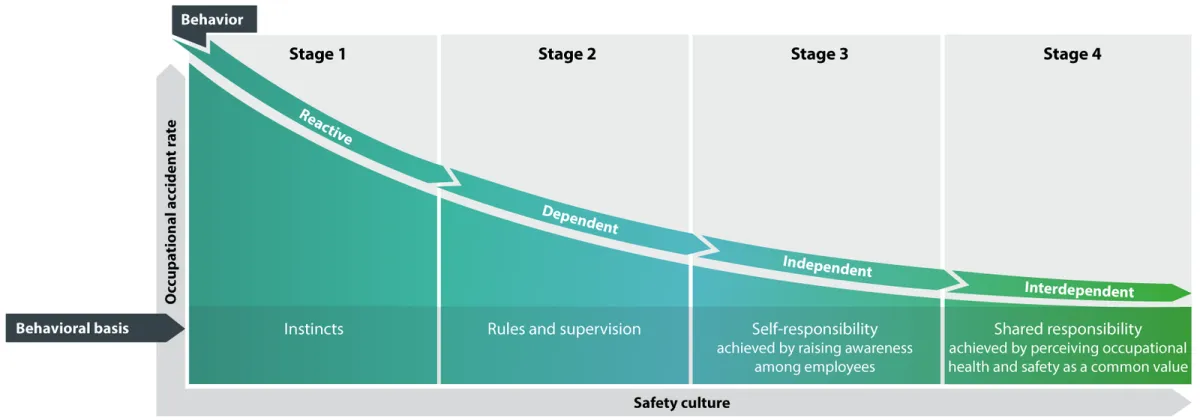
Dupont Bradley Curve
What Do Your Employees Do When No One Is Watching?
That question tells you more about your safety culture than any audit, policy or incident statistic ever will.
The DuPont Bradley Curve exists for this exact reason.
It’s a safety culture maturity model designed to explain how safety decisions are actually made day to day, especially when there’s pressure, shortcuts, and no supervisor standing nearby. The model breaks safety culture into four stages: reactive, dependent, independent, and interdependent.
In a reactive organization, safety only shows up after something goes wrong. Rules appear after injuries. Work gets done first, and safety catches up later.
In a dependent organization, safety is driven by supervision and enforcement. Procedures exist. Training happens. People follow the rules because they’re being watched or because they have to.
In an independent organization, workers take responsibility for their own safety. They understand hazards, follow procedures even when no one is watching, and speak up when something doesn’t look right.
In an interdependent organization, safety becomes shared. Workers look out for each other. They stop work without fear. They help improve procedures instead of working around them.
Here’s why that last stage matters to companies.
Interdependent organizations don’t rely on constant supervision to stay safe. Hazards are caught earlier. Near misses are reported before they become incidents. Problems get fixed at the worker level instead of showing up later as injuries, shutdowns, or investigations.
That translates directly into fewer serious incidents, less downtime, lower claims, better retention, and more predictable operations. Safety stops being a cost center and starts acting like stability insurance for the business.
Now compare that to the first stage.
Reactive companies pay for safety in the most expensive way possible. They pay through injuries, WCB claims, downtime, investigations, legal exposure, fines, and lost trust. Work stops unexpectedly. Management reacts under pressure. Safety improvements are rushed and rarely stick.
It always costs more to fix safety after someone gets hurt than to build it properly in the first place. The DuPont Curve isn’t about being perfect. It’s about understanding where your company actually operates today and what it’s really costing you to stay there.
Because what your employees do when no one is watching is already telling you the answer.

